You told me what you were looking for in one word, and this whole proposal is built around it. Everything below is priced in the currency you named on our call: hours.
The problem, which you already solved once
Your first year solo, everybody thought it was just you. It was actually you directing a small army: contract attorneys on the side, Ivy League clerks doing third-year work as students. You handed a file over, said "we need a motion for summary judgment, focus on A, B, and C," and finished work came back for your red pen. You directed, they produced, and the income followed. Your words: those were the glory days. Unlimited people on tap.
Then the army went away, and every job it used to do landed back on one desk.
The reading. The laborious matching of law to facts. The 2 a.m. proofreading. The discovery drafted from scratch every case. The hearings prepped alone. You told me the word you're looking for from AI, and it's the right one: when you have a strength, you magnify it.
This proposal is short on purpose, because you also told me anyone can write 30 pages of slop. Here's the problem, the plan, and two ways to buy it.
The plan: rebuild your army
Not a metaphor and not another subscription. A working set of AI associates, built one at a time, each trained on your actual practice: your briefs, your standing instructions, your judges, your forms. What you called it on the call is exactly what it is: a little robot employee, a little Elon. Several of them.
They work the way you taught yourself to work (Tap each to learn more).
The reading clerk
Reads every production front to back without fatigue, maintains the master chronology and the who-said-what map, and hunts the thing you hunt: "testing the internal consistency of the relative narratives… the dog that didn't bark." Every finding cited to its exact page, so checking it is fast and trusting it is earned. It reads; you judge.time back: about half a day per major production, and the defensive re-reading mostly stops
The drafting clerk
Takes "focus on A, B, and C" and returns a draft that respects your 10-page rule, in your voice because it's trained on your best briefs, with the law-to-facts matching shown so you can check its work. "It is exceedingly difficult and mentally taxing to write 10 pages of brilliant prose." That discipline gets encoded, along with your signature move: fact pattern in, claims plus draft jury instructions plus outline of proof out, so the end of the case is predetermined even when you're tired.time back: 3 to 6 hours per motion; the first draft is the expensive part
The judge and opposing counsel avatars
Built the way you described them: one per judge, your two Business Court judges and the district judge you keep drawing, fed their real rulings and your years of orders. "Which of these arguments flies with her" gets answered before you walk in. And the sparring partner rides along: something that knows the file, argues the other side, chases concessions, and attacks your weakest link. Even spin up real time mock arguments (with voice interaction). "all day and all night… I don't take it personally if it's Claude." Honest boundary: pattern-informed sparring from real rulings, a sharper way to prepare, not a crystal ball.time back: 1 to 2 hours per hearing, and you walk in sharper, which is the part that wins
The discovery clerk
Keeps the database you spec'd yourself on the call: "standard interrogatory, standard request for production, standard request to admit… for breach of fiduciary duty, dissolution, merger, whatever the case may be." Your best sets and the ones worth harvesting, indexed by claim type, drafted in your exact format with your caption block and definitions. Nothing recreated from scratch, nothing lost with a chat session, and it compounds every time you close a case with a set worth banking.time back: 2 to 3 hours per set, every set, every case
The back-office clerk (ADA)
For the ADA volume docket that turned out "effing large. I mean, like, holy moly." This seat gets designed with your daughter, because she knows that workflow and I don't yet: the docket watching, the service, the returns, the repeating paper. Every page still routes through your eyes, because that's the rule and it's also the design. She stops being the system ("she is basically my AI at the moment") and starts running one.time back: hers more than yours, and at that volume it's real; sized honestly in the mapping session
The time-back numbers are my estimates, not measurements: correct them on the call, and the monthly scorecard is what turns them into facts. Stacked across a normal month of productions, motions, discovery sets, and hearings, they're where the ten-hours-a-week target in the math below comes from.
Two things make these better than the army you had. You told me you'd take reliable over brilliant, because brilliance that doesn't show up is worthless; these show up every day, around the clock, on holidays, from your phone. And unlike every clerk you ever trained, they get smarter every month, because the AI brains underneath keep improving and the training SOPs we give them compound, they also never walk out the door.
You gave me the other frame that matters: off the rack or bespoke. The platforms are off the rack, cut for the average firm; you sat through their pitches and passed, and the man at CodeX who could afford all of them told you why: he does it all with Claude. Your clerks are bespoke. When Claude told you "this doesn't sound like you," you saw the power in that. That's the thread the whole wardrobe gets cut from.
As important as what we will build, we'll be clear on what we definitely won't build: nothing that touches strategy, the malfeasance-versus-nonfeasance calls, talking to a jury, or your eyes on the page. "No Claude is going to substitute for me on that." Correct, and nothing here tries. I'm also not touching the case reading you love. The clerks take the burden; the judgment, the wins, and the reading you'd do for fun stay yours.
Two ways to get there
Path one: Done With You - I teach you to build them$1,500 / month
The AI Personal Trainer offer I mentioned that I run with Kyle:
Two 45-minute working sessions a month on your screen, messages anytime in between. We build the clerks together, and you learn the craft as we go: how to train them, direct them, check them, tighten them. You develop the skill yourself, which you told me is where you're headed ("once I ramp to a certain point, I'll be programming right alongside you").
This path takes you there. Honest trade: it moves at the speed of your calendar, and you're in court almost every day, so the clerks arrive over months, not weeks. Cheaper, slower, but the skill is permanently yours.
Cancel any month.
RecommendedPath two: Done For You - I build them for you$5,000 / month, everything included
We build the job description together, then out comes a new clerk.
What you get:
Your first clerks working inside month one, starting with the fastest time-back, and the full set hitting high gear in month two.
New clerks built as your cases surface new uses for them, one in training at a time, as fast as they can be stood up properly. No per-project quotes or having to negotiate change orders.
Your time in: about one hour a week. A debrief, a red pen on what came back. One hour to buy back ten.
They're with you anywhere: on your phone, from the courthouse hallway. Talk to them or type to them.
Secure and private, set up the way an attorney who sells confidentiality needs: the business-grade terms where "never trained on your work" is the contract default, not a setting. That's part of the build, not an extra.
Everything on one number: your AI platform usage, hosting, all of it inside the $5,000. No surprise line items.
A one-page performance review every month: which clerks did what, and the hours they gave you back, counted.
They keep improving. AI is moving fast, we stay on top of the latest developments and implement them when they make sense. The bench you have in month six outworks the one you had in month two.
And it doesn't run at $5,000 forever. Once the clerks are dialed in and you run out of ideas for new things to automate, we dial back to hosting, maintenance, and support at $1,500 a month: they stay healthy, secure, and on the newest models, and you stop paying for the build consultant you no longer need. And if we stop entirely, everything stays yours: the clerks, the training, the library they learned from.
The math, in your numbers
0 hr
a week: your time in
0 hrs
a week: bought back
$0K
a month of time
$0K-$0K
a year for the whole bench
You gave me the yardstick yourself: an employee getting paid $50 an hour should make you two to three hundred. So hold this to that standard. One junior associate runs $150,000 to $200,000 a year before recruiting, training, and the risk that the brilliant one flakes. Path two is $30,000 to $60,000 for a set of specialized clerks that don't sleep, don't quit, and improve monthly.
And the return side: I'm guessing your time is worth $500 an hour (correct me if I'm way off), once we get rolling, I think a good target is to aim for ten hours a week recovered. Roughly $20,000 a month of time you can leverage how you best see fit.
Either path starts as a two-month pilot, enough time to see the results. We count the hours in the monthly scorecard, and at the end of month two we look at it together and decide: continue, or stop. If it stops, you keep everything built to that point.
My recommendation
Path two. Not because it's the bigger number, but because of what you told me: you're slow to start and you're in court almost every day. Path one's only real discount is that you pay with calendar instead of cash, and every month of calendar costs you the ten hours a week you're not getting back yet. Path two has a clerk reading your record by week two. If what you want most is the skill in your own hands, path one is real, I run it happily with Kyle, and you can switch down to it once the bench exists. But you asked me to quote you leverage, and path two is the lever.
AI Personal Trainer - Done With You$1,500 / month
Teach you everything you need to know to build your clerks. Two 45-minute 1:1 sessions a month. Plus ad-hoc questions via txt whenever you need help. The clerks arrive over months; the skill stays with you. Cancel any month.
Done For You - I build it$5,000 / month, all in
Clerks working in month one. One hour a week of your time. AI platform usage, tools, hosting, and security included. Settles to $1,500/month hosting, maintenance, and support once the bench is built.
The next step is a short call
Bring your questions, correct my numbers, and pick the path that fits.
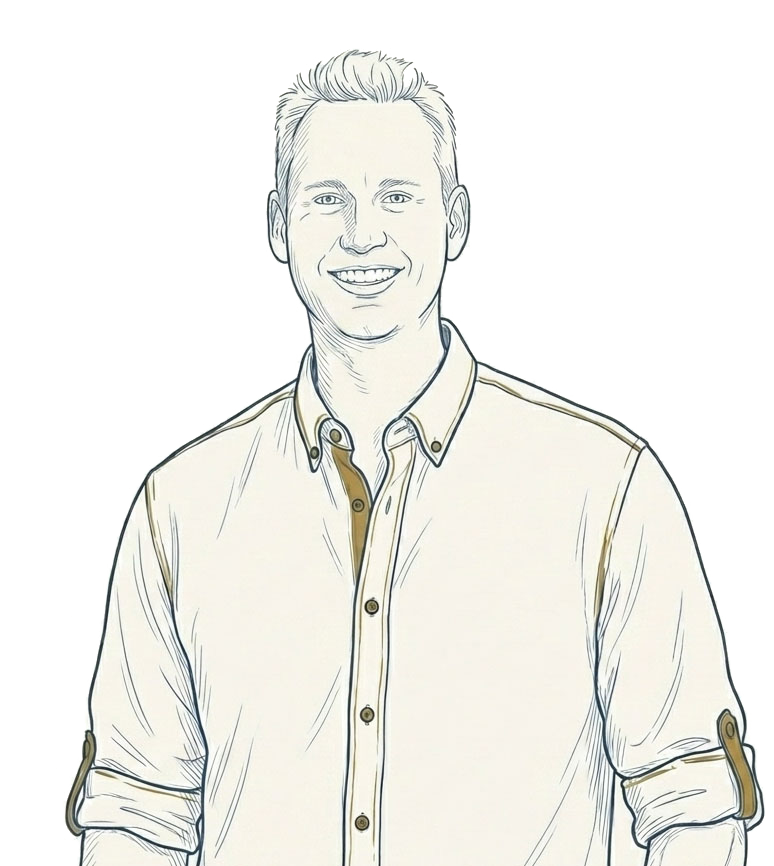
James Hollister is a father of 4 girls that he is raising with his wife in the small town of Duvall WA, just east of Redmond in the hills of the scenic PNW landscape of the Snoqualmie River valley.
He grew up in Las Vegas and fell in love with building software when he was a freshman in high school. He has been trying to solve problems for people with technology for over 20 years. Most of his early career was working with small businesses as he learned his craft and worked his way through university at UNLV. More recently he joined big tech when he moved his family to the Seattle area.
His experience with machine learning and AI is diverse. His first encounter with Large Language Models was with OpenAI's GPT 2 while working at Microsoft in 2020 within their Teams chat bot division. He then got to apply ML to predicting trucking rates while working within Uber's Freight logistics organization. More recently he moved to Amazon to help build their satellite internet offering and used machine learning to understand how to build and operate a fleet of thousands of low earth orbit satellites. He now builds agentic AI systems to help operate Amazon.com's massive fulfillment network.
As the developments within AI continue to accelerate he saw the enormous opportunity to help the millions of small and medium sized businesses adopt and adapt to this new world. Big tech no longer feels like the right place for him to make an impact. So he's hanging up a shingle and is excited to talk to anyone that is feeling left behind when it comes to AI. He hopes to build a practice doing this, similar to Lee's, where reputation does the marketing and the people he's served keep sending him the next ones.
The company he's starting is called Blue Bridge Logic. A nod to the Novelty Hill bridge he crosses every day as he leaves to commute into the city and the one which welcomes him home to the small town community he loves. That's the kind of attention he intends to bring to your practice.
Appendix: the rack I checked before proposing bespoke
You told me the CodeX story: the man who could afford every big platform tested them and decided he could do it all with Claude. I didn't take that on faith, and you shouldn't take my proposal on faith either. I checked roughly sixty tools against your specific week before writing a word of this. Here's the rack, so you can see the bespoke suit was cut with the alternatives on the table. A handful earn a place as equipment your clerks will use (marked hired); the rest, here's why they lost.
One warning about the cheap end of the rack before the list. A low price isn't a reason. Several of these cost less than a lunch and would still cost you, because they're general-purpose: they don't know your practice, and each one adds another app, another login, another place your text lives, and another thing asking for attention. Cheap noise is still noise. The bar isn't price; it's whether a tool removes work without adding management.
The big platforms · 12 checked
Harvey: no solo pricing, built for the flashy towers downtown. You passed at the seminar and you were right.
CoCounsel (Thomson Reuters): $639 a month, and it lives in the Westlaw ecosystem. You told me Lexis is your research home; this buys a second ecosystem to maintain.
Everlaw: premium e-discovery, floors north of $20,000 a year, built for firms with litigation-support staff.
DISCO: same weight class, per-gigabyte pricing that makes sense at firm scale.
Filevine: you liked the guys; it's a platform for plaintiff shops running volume dockets, not a bespoke commercial practice.
Paxton AI: mid-market AI assistant tuned for the average firm; duplicates what the Claude-plus-Lexis stack you described already covers.
Alexi: same lane as Paxton, same verdict.
Callidus / StrongSuit: same lane, mid-rebrand.
Junior Associate: generic, and the name is the whole pitch.
Spellbook: contracts and deals; wrong vertical for litigation.
Reading the record & chronologies · 9 checked
CaseFleet ($140 a month, free trial, no contract): the modern CaseMap and the one genuine contender here; its AI tier keeps every extracted fact click-linked to its source page. Worth a trial on one closed matter next to the reading clerk; it earns a seat only if that click-through wins you over.
CaseMap+ AI (LexisNexis): the tool you were trained on, modernized in the cloud; heavier and pricier than CaseFleet for a solo practice.
Clearbrief (~$300 a month): Word-native, links every assertion in a draft to the exact page of the record; real and Nevada-vetted, but one step downstream of your actual pain. Revisit only if record-cite volume explodes.
MasterFile: the budget CaseMap alternative; its AI is behind CaseFleet's.
TrialLine: visual timelines for mediation and trial presentation, not analysis.
Marveri: built for M&A due-diligence review; wrong vertical.
Logikcull (~$395 per matter): back-pocket option if a monster production ever lands.
Dodonai ($30 a month): new, cheap e-discovery, and a good example of the warning above: all its claims are vendor-sourced so far, and cheap-but-unproven still costs you the time of finding out. Watch list, twelve months.
Parrot: deposition summaries only; one slice of one job.
Research & drafting · 2 checked
Midpage ($99 a month) hired: plugs verified, linked case law straight into Claude. This is the drafting clerk's law library, and the answer to the rule you already live by: the drafting tool is never the source of a citation.
Lexis+ Protégé and Vault: before any new spend here, one free call to your Lexis rep to learn exactly what your current plan already includes; whatever the answer, Lexis stays your cite authority.
The 2 a.m. quality nets · 6 checked
BriefCatch ($780 a year) hired: the legal writing checker built from federal-brief editing patterns; run-ons, punchiness, sag. A rule-based Word add-in, so client text stays on your machine.
WordRake: now part of the same company as BriefCatch; covered by that choice, so it isn't a separate buy.
PerfectIt with American Legal Style (~$70 a year) hired: the deterministic consistency checker for defined terms, numbering, and capitalization. Also rule-based, also local.
Grammarly: cheap and everywhere, and that's exactly the problem. It's general-purpose, knows nothing about legal writing, and adds another place your client text goes. Noise, not a net.
TypeLaw: a done-for-you brief formatting service; plausibly useful for an appellate one-off, not a system.
Microsoft Editor: if you draft in Word you likely have it already. A seatbelt, not a net.
Discovery · 4 checked
Briefpoint ($89 to $210 a month, demo required): the one commercial discovery generator worth a later look, and only after your bank exists, because the bank is yours and free.
AI.Law: young; the same bank-first logic applies.
EsquireTek: discovery responses aimed at plaintiff volume practices.
HotDocs: enterprise document assembly; overkill by an order of magnitude.
The ADA back office · 11 checked
DocketBird (~$25 a month) hired: watches the federal docket, auto-downloads every new filing, calendars the deadlines. Safe to start today because it only monitors; it changes nothing in the workflow.
Proof (~$75 a serve) hired, when the map says so: nationwide service of process with proofs landing back in the file electronically.
Gavel (from $83 a month): on the document-assembly short list, chosen only after the mapping session with your daughter shows which paper actually repeats.
Clio Draft: the same document-assembly lane, and the right pick only if Clio turns out to be part of your stack, which is one of the free checks we run before buying anything.
Clio Manage workflows and Clio Duo: same caveat; worth knowing what you already have before adding anything next to it.
ECFiler ($99 a month): one-click federal filing. Philosophically perfect and too young to trust with court credentials; the filing click stays human.
InfoTrack: filing-and-serve integration plumbing for bigger shops.
ECFX Notice: court-notice automation at firm scale.
Zapier and Make: automation glue, not clerks. Cheap and general-purpose, and left on their own they mostly wire noise together; they'll show up quietly inside builds where boring wins, and nowhere else.
Smokeball: a whole practice-management platform; switching systems isn't the problem this proposal solves.
MyCase / Assembly Neos: same category, same verdict.
Judges & sparring · 9 checked
Trellis ($199.95 a month judge tier) hired, one month as a data purchase: the only judge-analytics service with real Clark County state-court depth. The 14-day trial confirms it actually has your three judges before any money moves.
Lex Machina: Nevada is one of its enhanced states, and whether it's already inside your Lexis plan is question three on that free rep call.
Westlaw Litigation Analytics: real capability, but it means buying into a second research ecosystem to get it.
Pre/Dicta: predictive motion modeling, federal-centric; Nevada state-court fit unproven.
Vincent AI (vLex): worth one look for its bar-association angle; otherwise it duplicates what you'd already have.
Bloomberg Law: strong on federal judges, no evidence of Nevada state-judge analytics, big-firm pricing.
MootQourt: an argue-aloud AI judge that interrupts and pushes back. Intriguing, but pricing and data handling are unpublished, so nothing real goes into it until the vendor answers those questions.
StrongSuit Case Coach: an argument simulator inside a suite you don't otherwise need.
Student moot-court AIs (a dozen-plus of them): built for 2L practice rounds. Cheap, general-purpose, and not for real evidentiary hearings.
That's the rack. The pattern is the one you predicted at CodeX: the tools worth keeping are small, specific, and earn their keep as equipment; the platforms are cut for somebody else's practice; the cheap general-purpose ones mostly add noise. And the thing that actually rebuilds your glory days isn't on a shelf, because it's made of you.